
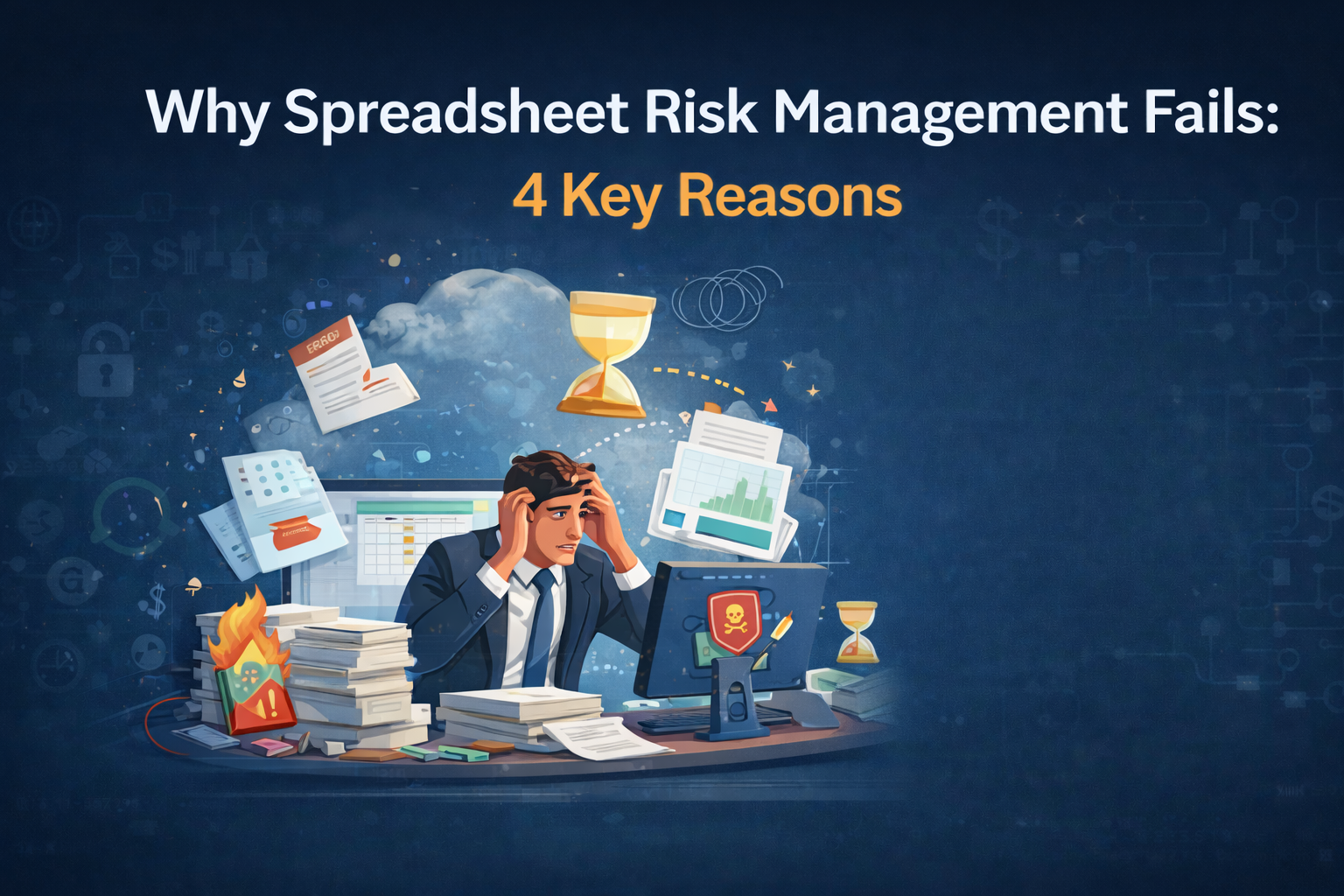

Why Spreadsheet Risk Management Fails in Modern Enterprises: 4 Critical Gaps
The way many organizations still manage risk is, itself, a risk.
Spreadsheets are passed around on email. Risk registers are updated quarterly – if someone remembers. Audit evidence is pulled together in a scramble two weeks before the auditors arrive. Control tracked in files that live on one person’s desktop.
It worked once. It doesn’t anymore.
Business environments are changing faster than ever. Risks are multiplying. Cyber threats are evolving faster than most teams can track. Customers expect trust and transparency. Regulators want to see evidence in real time. Meanwhile, management wants dashboards, not decks built from stale data.
The gap between what is expected and what manual processes can deliver is widening every quarter and that is where failures happen.
Cost of “Good Enough” Approach
Most organizations underestimate the true cost of manual risk management – not only in terms of compliance exposure but in lost time, operational efficiency, diminished credibility and weakened decision-making quality.
Blind Spots – Limited Enterprise Risk Coverage
When risks are tracked manually across disconnected processes and underlying systems, no one has a complete view of the risk landscape. Each department manages its own register, but enterprise risk does not operate in isolation. It emerges at the intersection of functions – across IT, Operations, Compliance, Finance and third parties.
When risk management lives in silos, the organization loses visibility into how those risks interact, amplify, or cascade across the enterprise.
A PwC Global Risk Study found that 59% of organizations experienced a major risk event over a three-year period, with many acknowledging that these risks were not identified early due to a lack of integrated and enterprise-wide risk coverage.
Low Data Integrity and Accuracy
Every manual entry is a chance for error or outdated information, duplicated records, inconsistent formats and human error. Poor data quality weakens compliance reporting, drives inefficiency, creates audit challenges and fosters a false sense of confidence.
According to Gartner, poor data quality costs organizations an average of $12.9 million per year, largely caused by manual data handling and inconsistent record – keeping.
Delayed Risk Identification and Response
Siloed processes cause significant delays in issue identification and remediation. Teams spend valuable time locating the right documents, validating versions, reconciling data and sending follow-up emails instead of focusing on addressing and mitigating risks immediately.
McKinsey research shows that employees spend nearly 28% of their workweek searching for information and managing emails, which increases operational risk.
Lack of Real Time Risk Intelligence
Manual risk frameworks do not support continuous risk monitoring. Periodic reports that take weeks to compile are already outdated by the time they reach management. This forces organizations to adopt a reactive risk management approach rather than being preventive. Leaders end up reacting to problems that could have been prevented if only they’d had visibility when it mattered.
According to PwC, many organizations lack early visibility into emerging risks, which directly contributes to unexpected risk events and business disruption.
In today’s regulatory and cyber-sensitive environment, delayed reaction is very expensive. Fines, operational losses, reputational damage, and erosion of customer trust are all traceable back to processes that simply couldn’t keep pace.
The Structural Shift from Manual to Intelligent Risk Management
Moving away from manual risk management doesn’t mean replacing people with software. It means giving people the right infrastructure to do what they’re hired to do: think critically, make judgment calls, and manage risk proactively.
Modern GRC platforms bring all risk and compliance activity into a single environment. Instead of fragmented files and tribal knowledge, organizations get a unified view of risks across the enterprise, automated workflows that ensure nothing falls through the cracks, real-time dashboards that reflect what’s actually happening today, clear ownership and accountability at every level, and built-in audit trails that make regulatory examinations straightforward rather than stressful.
Automation doesn’t remove human judgment. It removes the operational friction that prevents people from exercising it. Tasks get assigned and tracked without manual follow-up. Evidence is captured as work happens, not reconstructed after the fact.
Reports generate themselves from live data instead of requiring someone to copy numbers between tabs.
This creates something manual processes never can: consistency. The process runs the same way every time, regardless of who’s involved or whether someone is on leave. That repeatability is what regulators want to see. It’s what boards need. And it’s what risk teams deserve.
Where Wissda Fits
At Wissda, we help organizations make this transition — from scattered, manual risk tracking to a structured, AI-enabled approach that works in the reality of daily operations, not just in theory.
We work with financial services firms, banks, and enterprises to centralize risk data, automate the workflows that consume your team’s time, and deliver the real-time visibility that leadership needs to make confident decisions. Our deep domain expertise in GRC — combined with hands-on experience implementing vendor platforms — means we don’t just deploy technology. We help you design the operating model around it.
The Bottom Line
Risk management that depends on spreadsheets and email chains isn’t cautious. It’s fragile. Organizations that make the shift to structured, automated, and intelligent GRC now will respond faster, demonstrate stronger controls to regulators, and build the kind of operational resilience that earns trust — from boards, from customers, and from the market.
The question isn’t whether manual risk management is ending. It already has. The question is whether your organization is keeping pace.

0 Comments