
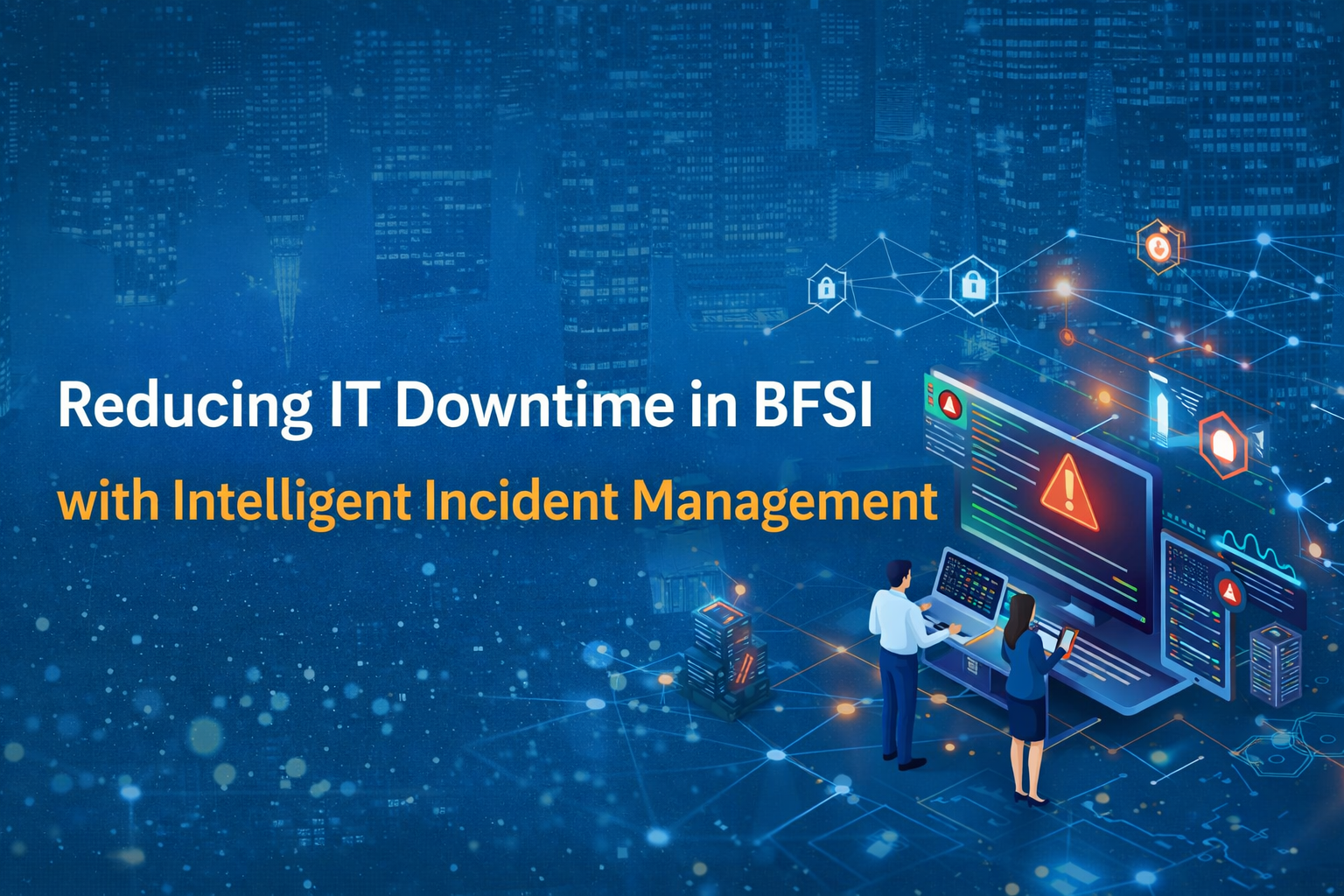

Reducing IT Service Downtime in BFSI with Intelligent Incident Management
Reducing IT Service Downtime in BFSI has become a critical priority for banking, financial services, and insurance organizations. IT downtime is no longer just a technical issue; it is an enterprise risk event with direct implications for customer trust, financial performance, and regulatory exposure.
As digital channels, real-time payments, and always-on customer expectations become the norm, tolerance for service disruption has effectively disappeared. For CIOs and CROs, the question is no longer whether incidents will occur, but whether the organization can detect, contain, and explain them quickly enough to limit downstream impact.
Why Downtime Carries Outsized Risk in BFSI
Downtime in BFSI environments carries disproportionate consequences because system availability is directly tied to regulated customer activity — from payments and account access to lending, trading, and insurance servicing. Even partial outages or degraded performance can interrupt transactions, overwhelm customer support teams, and escalate into governance and compliance concerns.
A widely cited 2014 Gartner analysis estimated the average cost of IT downtime at approximately $5,600 per minute, or more than $300,000 per hour, with financial services among the most impacted sectors. While few comprehensive industry-wide benchmarks have been published since, it is broadly accepted that the real cost of downtime today — driven by cloud scale, real-time processing, digital dependency, and heightened regulatory scrutiny — is significantly higher than it was a decade ago.
What is Intelligent Incident Management?
Intelligent Incident Management represents a shift from reactive, ticket-driven response toward a risk-informed, data-driven operating model. Rather than relying on manual triage and fragmented ownership, it integrates real-time visibility, automated response, and post-incident learning into a single control framework.
A Hard Truth: Manual Incident Management Is a Quiet Risk
Organizations that still rely heavily on manual incident response are accepting a form of unquantified operational risk. Human-driven triage slows detection, increases variability in outcomes, and weakens post-incident documentation — precisely the areas regulators and boards increasingly expect leadership teams to control.
At scale, manual incident management rarely fails loudly. It fails quietly, through extended recovery times, inconsistent evidence, and repeat incidents that erode confidence over time.
How Intelligent Incident Management Reduces Downtime
When implemented effectively, intelligent incident management reduces downtime by strengthening control across the entire incident lifecycle. Continuous monitoring enables earlier detection of anomalies before they escalate. Automated triage and routing reduce delays caused by unclear ownership or manual handoffs. Post-incident analysis surfaces systemic issues, allowing teams to prevent recurrence rather than repeatedly applying temporary fixes.
The result is not only faster recovery, but more consistent outcomes and fewer high-impact disruptions.
The Regulatory Dimension of Incident Management
Regulatory expectations increasingly reflect this shift, treating availability, response discipline, and documentation as core elements of operational resilience rather than technical hygiene.
Regulatory Callout:
The New York Department of Financial Services’ Cybersecurity Regulation (23 NYCRR Part 500)— first implemented in 2017 and significantly updated with amendments taking full effect on November 1, 2025 — requires NYDFS-regulated financial institutions to maintain robust cybersecurity and incident response programs that ensure system availability, governance oversight, and clear documentation for audit and compliance readiness. As a result, IT service disruptions must be managed and evidenced in ways that withstand regulatory and supervisory scrutiny, elevating incident management from an IT concern to an enterprise compliance obligation.
Why This Matters Beyond IT
For BFSI organizations, reducing downtime delivers tangible business value. Customers experience fewer disruptions, operational teams face less firefighting, and leadership gains greater confidence in service reliability. Just as importantly, organizations strengthen their ability to demonstrate control, traceability, and preparedness to regulators and auditors.
For CIOs and CROs, intelligent incident management becomes a practical lever for aligning technology operations with enterprise risk objectives.
Closing Perspective
In modern BFSI environments, incident management has become a leadership concern, not an infrastructure one. Organizations that continue to treat it as a standalone IT process will face avoidable downtime and growing risk exposure.
Those hat embed intelligent incident management into broader risk and compliance frameworks are better positioned to limit disruption, satisfy regulators, and maintain customer trust — even when incidents inevitably occur.
Wissda works with inancial services organizations to strengthen operational resilience by aligning incident management with risk and compliance frameworks, helping teams reduce downtime while improving governance and audit readiness.


0 Comments